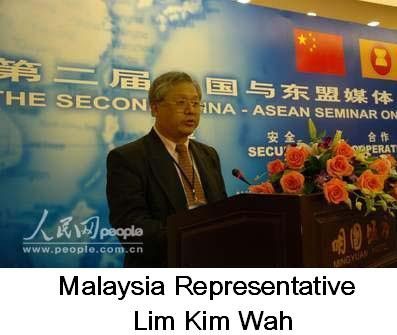
By Lim Kim Wah,Assistant Director,Centre For Strategic Information Management,Ministry Of Information Malaysia.
 http://www.people.com.cn/BIG5/guoji/8212/36645/37492/2772599.html
 Distinguished guests,
Ladies and gentlemen,
Let me begin by thanking the organizers for giving me the honour of presenting the speech of “Cooperation between Chinese Media and Media From ASEAN A Way Forward” at this auspicious function.
Let us be reminded that although media are both social construction and human inventions, but there appears that media power is so powerful that it can shape up the world. They can shape up broadly the values and perceptions. They play a major role in shaping the creation and accumulation of reputation. Although the media do not directly tell people how and what to think, but they do tell people what to think about and perhaps even how to think about (Agenda-setting theory) thus, the public interest is constrained by the interest and wishes of the proprietor.
Ironically, the media is so powerful and influential that governmental organizations put a major focus and attention to monitoring the role of the media. It is apparent that when the media act together, they are even more powerful. In this context, media should have a purposive and supportive role in mind and action in order to use this tremendous power constructively to build up rather than destructively to tear down.
It says power corrupts itself and absolute power of the western media corrupts absolutely. By the conscious exclusion of values, the western media put values that they are aware of to one side in order to achieve the objectives. Consequently, if the media is against something, then the reporting will reflect the standing. They might be wrong and bias. If they are wrong but still insisted on promoting it, then the damage done can be considerable and serious.
There appears to be no doubt that western media enjoys dominant role in disseminating news but western views reflect western bias. Western media exploit their superiority through unfair reporting to be biased against the East, it augments the misunderstanding and bias of the West against undeveloped or developing countries.
By any standard, reports should always be balanced. What is done right should also be reputed alongside what is done wrong. The media can play an active role in disseminating the correct side of the story, to create mutual understanding, to promote what is good and banish what is bad. It can help to build a better, fairer and more justice world.
Evidently, the media is always been given a central focus place in the dissemination of information. Practically everything under the sun can be disseminated through the printed words, pictures, radio, television and of course internet. Thus media cannot be contained and confined. The whole world can be reached in real time and at any time by or through media instantly and immediately.
Today the world media is hugely western dominated. They are neither controlled by the government nor own by government agencies but own by private interest groups of the west.
There are many instances of the media unfair and discriminating to underdeveloped countries. Almost without any exception, the western media willingly aggravate matters by exaggerating and telling deliberately slanted stories about undeveloped countries.
Currently, there is so much, misunderstanding among countries and people. The sole cause of misunderstanding is arising from misinformation, disinformation or unable to access the right information from the right sources. The media through perpetuates the confrontation between western and third world countries. Perhaps increase profit and influence power are to be gained from this but for sure more would be gained if no confrontation.
Ironically, it is morally wrong for western media with their own agenda to control the press and use it to spread misinformation. The media to be controlled by people who actually represent no one.
Role of Media
The media can play a role in international governance by affecting reputation by two ways. First, media attention can drive politicians to introduce laws in the belief that inaction would up bring their reputation both at home or abroad. Second, media attention affects reputation in the eyes of society at large and leaders acted in part to protect their public image.
The media always has its own agenda. It wants to shape the world. It is not what the world or the leaders of the world think that shape the reporting by the media. It is what the media thinks, what the media considers to be right for the world that counts with media.
As right information can drastically reduce the animosity and suspicious, constant conflict and confrontation among countries and of course people. In fact, the media can mitigate by giving the real picture, telling the truth, thus create a better society for each and everyone.
While effectives international cooperation is vital in bridging the widening relation, more importantly it allows for representation of views of the developing world in formulating international policies on the use and expansion of information technology.
If the western media is ethical and responsible, it should utilized their vast influence and power to spread knowledge, shape the civilization of the modern world through promoting technology and science, help bringing nations closer together, promote the best in human values, reduce conflicts between and within nations, help people of different ethnic and culture to understand and cooperate for mutual benefit.
Cooperation A Way Forward
From the Chinese media and media from ASEAN context, the role of the media should focus in terms of its dissemination of information and the cooperation between Chinese media and media from ASEAN countries.
In the spirit of this challenge, it is outmost important for the media to understanding the differences and act on the commonalities to reflect the interests of developing countries. A successful collaborative problem-solving approach rather that polarization to achieve peace, security and prosperity may be the answer to our resolve.
It is evident that entering this globalization environment, media should appreciate the independence status given to them. Through giving place to all opinions, highlighting the common interests of the parties, exploring effective ways to reconcile and solve problem and educating audiences on collaborative approaches in problem solving, media might be accepted by public and gaining the highest honour.
Practical and Feasible Media Strategies
Despite the negative progression of the imbalance and disparities of the western media, practical and feasible media strategies should be adopted to intensified cooperation and strengthen the relations on a bilateral basis. The efforts of providing practical guidance to media to be focused to enhance bilateral relations should be emphasized to achieve win-win results.
In addition, in order to stand against the information crush of the western values and weak competitive power media of the east, the media of the east should take all necessary steps for maximum interaction among their media organizations and cooperation at various levels.
As such, the active measures to construct a framework for broadening and deepening bilateral relations through increasing flow of information is by far needed. It would anticipate potential problems and provide a means for dealing with them to further promote broader relationship and strengthening the existing friendship.
The necessary steps for further strengthening existing media cooperation recommended to be adopted are as follows :
a.China-ASEAN Bilateral Communication Research Centre
The social and cultural implication of the free flow of information and transnational interaction by far is the key factor in globalization era. Communication apparatus emerged as the utmost important element to mediate people-to people contact.
Ironically, Communication Research is the domain of academic institutions, government and intergovernmental as well as non- government organizations. It plays a major part to organizing every aspect of the contemporary life, from broad patterning of social institutions and cultural systems to intimate everyday encounters and people’s understandings of the world and their sense of themselves.
The east usually referred to FAO (Food and Agriculture Organization), UNFPA (United Nation Population Fund), AMIC (Asian Media Information and Communication Centre), East-West Centre to learn about itself in which some information are not reliable and unacceptable as it is western slant bias in nature and not taking local perspectives into consideration. On the other hand, the east should fully utilized the OANA (Organization Asia Pacific News Agency), SNNI (Smart News Network International), ABU (Asia Pacific Broadcasting Union) and many others which is highlighting the perspectives of the third world countries.
The main objective of Bilateral Communication Research Centre is to forge a greater cooperation and understanding through direct exchange of information news and broadcast materials, to foster a better relationship and greater understanding between China and ASEAN, to establish a central depository that will allow China and ASEAN to share information, news and broadcasting materials as a way to promote peace, unity, solidarity and shared prosperity, to ensure that the news about the China and ASEAN countries are being reported in a rapid, objective, fair and balance manner and in accordance with the east’s perspective, and to pave the way for other opportunities which would enhance cooperation as a means to promote news, broadcasting and film industries.
In other words, it is a one stop centre where all information will be made available first-hand and more pertinently presented according to the east’s perspectives. It also serve as the centre to counter the erroneous views and opinions as well as negative perceptions of the western media and rebuttals will be able to transmit to the viewers.
Basically, it act as a centre to provide service and facilities for China and ASEAN countries in order to get fast, accurate, trustworthy and balance news and broadcasting programmes and become premier information exchange operation centre which emphasis on peace, solidarity, development and well being of China and ASEAN nations.
By developing the credible networking and creating a comprehensive Bilateral Communication Research Centre, the insight communication issues and problems from local perspective can put forward will undoubtedly increase the competitive power.
b.Developing on-line Internet and website systems :
Undoubtedly, developments in internet has significantly shaped our lifestyles. The internet has made worldwide distribution of information available to everyone thus changing the whole scenario of the world.
The internet is a computer network made up of thousands of networks worldwide with growth rates exceeding all expectations. Although it has taken 5 years to reach 50 million users, but no one knows exactly how many computers are connected to the internet. It is certain, however, that these number is in millions.
The main difference between internet and traditional media is that, internet is a two-way communication medium that break the bonds of geography and allows users to talk back, even communicate to each other electronically with similar interests all over the world.
No one is in charge of the internet. There are organizations which develop technical aspects of this network and set standards for creating applications on it, but no governing body is in control. The Internet backbone, through which Internet traffic flows, is owned by private companies.
An internet user has access to a wide variety of services: electronic mail, file transfer, vast information resources, interest group membership, interactive collaboration, multimedia displays, real-time broadcasting, shopping opportunities, breaking news, and much more.
Technological advances is the excuse for doing away with the independence of nations and replacing it with interdependent nations, so China and ASEAN countries should exploit this situation for further strengthening their existing cooperation by helping each other in developing internet and website systems for better dissemination and transborder flow of information.
c.Newspaper :
Newspaper emerged as a powerful medium. It has fairly good reach among the population. It has been said that the pen is mightier than the sword. If one’s writing can reach hundred of millions of people worldwide, what can happen if the intention is evil. On the other hand, if the intention is good, how much the world benefits.
According to McQuil (1984:94-96), it can be said that Malaysia, Singapore and Indonesia are among the countries that practice “Development journalism”. The characteristics of which accepted by the media that they have a role to play in carrying out positive development tasks in line with nationally established policy that journalists have responsibilities as well as freedom in news gathering that the state has a right to intervene in media operations for development ends.
Philippines and Thailand which claim to have free press, lean towards the Western liberation tradition of journalism which is staunchly opposed to government intervention and involvement in newspapers. But there are moves to encourage various forms of development journalism within their media cultures.
According to Merrill (1988), press has the potential to eradicate wrong impressions and sterotypes and reduce tensions, at the same time, it also can create fears and causes anxieties within society.
Subsequently, Chinese and ASEAN authorities should exploit the public opinion influencing power in shaping images and stereotypes about people and nations. All events and press statements give any number of scenarios and revealed the existing current situations should grow and develop to emphasize the complementarities of bilateral interests.
d.Television:
TV has received increasing attention over the years, but has been accorded decreasing esteem. People watch it more but enjoy it less. It receives the greater shared of people’s free time. It plays the dominant role in the dissemination of information.
TV can inform the viewers about the cooperation through its various programmes and quickies. It has taken 13 years to reach 50 millions users.
There are three ways in which television broadcasting could bring about the cooperation. One way is through the use of foreign programmes in national TV transmission. The second is through spillover of TV programmes from national television of one country to the broadcasting space of its neighbours, thereby making it possible for the citizens of the neighbouring countries to receive it. Finally, the planned transmissions of TV programmes internationally through satellite to be received by foreign countries.
In the era of globalization, some governments are openly skeptical towards certain technologically rich western nations that dominate distribution of global news. It is said that the coverage of international news with a western negative slant are : The Associate Press (AP), United Press International (UPI), Cable News Network (CNN), Agence-France Press (AFP) and Reuters.
Hence, both China and ASEAN countries News Organizations and Governments should frequently crossed with a great deal of fruitful exchanges programmes. It should also improve existing news network at the levels of television to increasing more flow of information in order to counterbalance the unethical and wrong perception reporting.
e.Radio :
It is often though that radio is a declining medium of communication. The facts, however, do not entirely support this view. In fact, radio is a popular medium among all audience groups and production cost is minimal compared with television and some forms of press production. A small inexpensive receiver that does not have to be directly connected to a modem and that can find a place in anywhere.
The power of radio not just to “inform,” “entertain,” “enlighten,” but to transform people’s lives. Radio uses sound and exploits the warmth and vitality of the human voice. It uses music to strengthen its appeal, create atmosphere and interest as well as for memorable messages. In addition audio communication has definite psychological advantages, and evidence also indicates that an aural message has a greater power of suggestion that a visual one.
Radio has another important characteristic – it is “solus” – with the added impact of being delivered to a captive audience and to family units. Repetition and increased impact is also gained from using more than one station where there is an overlap of audience.
Radio had maximum reach and is aimed essentially at the home audience, however, it had taken 38 years to reach 50 million users and radio listening has sharply declined inspire of its high availability.
The Chinese and ASEAN should exploit the radio services for disseminating information. Both authorities should use the opportunity to combine wide appeal with a first-class service of both counterpart information that add to the vitality of bilateral broadcasting.
The arrangements proposed should enable both sides to make a worthwhile contribution, particularly in exploring the potentialities of both China and ASEAN national and international radio news and encourage them to add further theirs notable record of achievement in sound broadcasting.
f.Movies Making:
The dramatic logic of the movies has become the primary bearers of myth and storytelling in our society, influencing our actions and affecting social change. The influence of movies in our lives is great.
Movies are made in fragments that are edited together in imaginative ways to create scenes that appear real but are actually highly constructed. Many viewers assume that a dramatic movie is happening like a play and that the camera is simply recording the events as they unfold in real time.
Nothing could be farther from the truth. Scenes are shot out of order; real locations and constructed sets are linked together at the same place; the camera "sees" action from impossible positions. Thus making movies produces exciting, innovative, award winning documentaries and drama's to be acquired commercially by Networks such as the ABC, National Geographic Television, Discovery Channel, BBC, NHK, TV3, Outdoor Life Network, and many others. Thus the political messages of the East range from overt to covert, the consciously executed to the unconsciously included. Whatever the case, the political theme surfaces in melodramatic story.
It goes without saying that movies making to propagate third world opinions and influential power is a strategically approach. The working group interaction at the official level, interpersonal or face-to-face communication, informal dialogue to have in-depth, frank and open discussion, exchange views pertaining regional challenges, international politic and security developments should be held to further deepen mutual trust and confidence. As movies power is political power, the outcome should be used to produce documentary films to propagate third world countries opinions and cultures.
Additionally, NGO interaction among youth (Youth exchange programmes), artists (Cultural performance, Drama shooting), experts and mass media representatives should be high lighted in movies as the cultural messages imbedded in those movies to tell something about Chinese and ASEAN and helped to create values of the third world countries.
g.Sport :
Being a common language of mankind, sport play an important role in the promotion to achieve peace, security and prosperity of the region.
Not surprisingly, ever since ancient times, sport has transcended differences in race, culture and colour and given expression to mankind’s aspiration for and pursuit of a peaceful and better world, as evidenced in the Olympic spirit that came into being more than 2,000 years ago.
Powerful as the media networks have always been, sports event should be used to resolve positively the old problems created by the oldies and new problems by the present. In the same way, the universal expression and aspirations to achieve peace, security and prosperity of the region, sports event can be more meaningful only if they attained a wide coverage by China and ASEAN media on a regular and continuous basis.
CONCLUSION:
Crisis is necessary to motivate change. The interests in cooperation can easily be overshadowed or even undermined by more ephemeral considerations.
However, underlying mutual interests and the need to move forward at whatever pace is achievable. As such, the business of bilateral relationship between China and ASEAN countries should be on-going, punctuated by specific differences but driven by the imperatives inescapable interdependence.
With these remarks, I end my speech, thank you.
 Lim Kim Wah - Third on the right

 Lim Kim Wah - Third on the right


